
Most teams for years have treated software like any other line they needed to push out the door. Build it, release it, fix it, repeat. That mindset worked when growth was mostly about process and speed.
Today the landscape is different. Everyone can move fast, all thanks to AI. AI has made every company faster. That speed advantage no longer belongs to anyone alone.
The difference now lies in how your product connects to partners, communities, and networks that extend its reach. This is where an ecosystem growth strategy starts to matter.
In the next 10 years, winners in tech will be those who operate as ecosystems and not isolated organizations. They are building tech ecosystems that multiply their influence every time another participant joins.
Why Traditional Growth Channels Are Losing Efficiency
Yes, AI did speed up creation, but let’s not forget that it also saturated every channel.
- Search: LLMs rewrite everything. Organic visibility drops.
- Outbound: Inbox noise is at record highs. Every rep sounds the same.
- Social: Feeds are flooded with recycled content.
- Events: Everyone’s hosting one. Fatigue sets in.
In this environment, the new advantage comes from trust, and trust scales through people and networks.
The Shift From Direct Reach to Distributed Reach
Instead of going to your audience, go through the people they already trust. Your best channels might not be your own.
They could be:
- A power user teaching others how to use your product
- A partner company building an integration
- A community running tutorials
- A creator explaining your category on YouTube or LinkedIn
Each one carries credibility you can’t buy. It’s built with time and collaboration, and it sits at the core of ecosystem-led growth.
Why Most Companies Struggle to Build Ecosystems
The biggest mistake leaders make is thinking ecosystem growth is a tech challenge. It’s not. It’s an alignment challenge.
When systems evolve faster than teams, internal friction appears:
- Data doesn’t sync
- Goals drift
- Partners operate without shared context
In our recent advisory work with software and logistics firms, the same symptoms appeared again and again:
- Digital projects that stalled after initial rollout
- AI tools bought but never adopted by frontline teams
- Product partnerships signed but never activated
The root cause is simple. Execution moves in isolation from strategy.
The Ecosystem Advantage
Ecosystems outperform traditional models because they distribute speed.
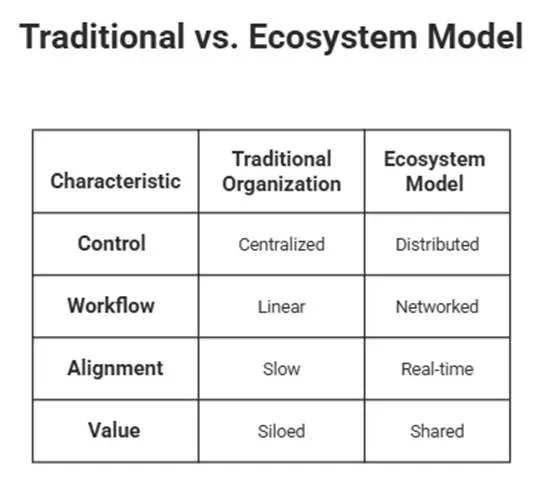
The change sounds structural, but it’s really behavioral. People, data, and products start behaving as parts of one connected system. That’s where growth happens through shared customers and network effects.
Why Ecosystems Work
They Multiply Every Other Channel
When partners share your message, inbound and outbound both perform better. Their voices make your product familiar before your sales team even reaches out.
Example: HubSpot’s “Loop Marketing” campaign didn’t rely only on ads. They partnered with well-known marketing voices who amplified the idea across LinkedIn and YouTube. For one week, it felt like the entire internet was discussing that framework.
This is what a distributed launch looks like, and it’s far more resilient than relying on a single channel.
They Speak Your Audience’s Language
People trust people more than brands. AI-generated content makes authenticity harder to judge, so buyers lean on creators, advisors, and operators they already follow.
Vanta sponsors Substack writers and podcasts its audience already reads. Their brand sits beside trusted voices, reinforcing value without a sales pitch.
Your ecosystem gives your brand a human voice in places where it otherwise wouldn’t fit.
They Make Lean Teams Powerful
AI hasn’t made GTM teams bigger. It’s made them leaner, with more pressure.
That’s why ecosystems act like team extensions.
Navattic works with micro-influencers who get early access to features and share insights publicly. It looks like a large content operation, but it’s actually distributed storytelling.
The smartest companies now build network leverage, not headcount.
They Are Adaptable by Design
Ecosystem strategies are not limited to creators or integrations. Partnerships can exist at every layer, from trade groups to customers.
Types of Ecosystem Partners

The takeaway is simple. You have options. Every startup can design an ecosystem that fits its category and stage.
How to Start Building an Ecosystem Growth Strategy
- Map your ecosystem: Who already reaches your audience? Creators, advisors, partners, communities, trade bodies
- Find alignment: What do they gain by collaborating?
- Co-create content: Webinars, blog posts, tutorials, integrations
- Amplify and measure: Share their content, track reach, reward success
- Systemize it: Build this into your GTM playbook as a function, not an experiment
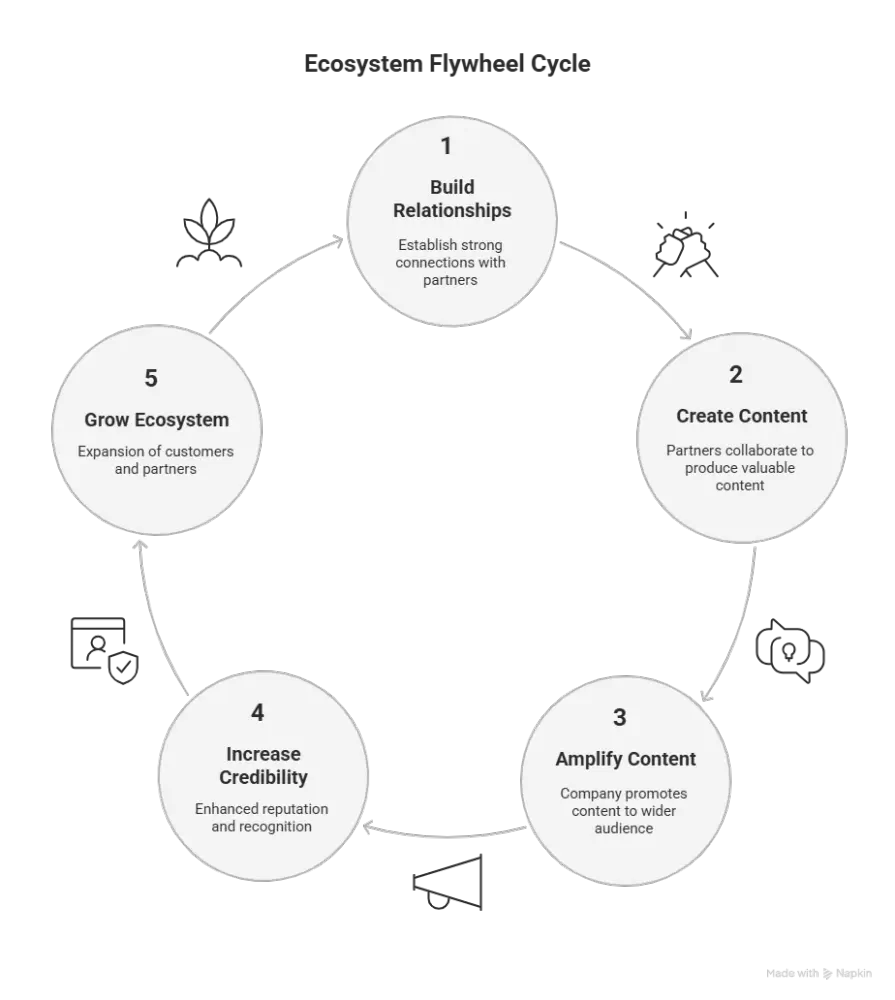
When executed right, the compounding effect appears:
More partners → more content → more credibility → more customers → more partners again.
That’s your ecosystem flywheel.
Conclusion
AI has removed speed as a competitive advantage, making distribution and trust the real growth drivers. Ecosystems outperform traditional models by distributing reach, credibility, and execution across networks. Companies that connect partners, creators, and communities into one system will scale faster. In 2026, your ecosystem, not your tools, will define your growth edge.
What is an ecosystem growth strategy?
An ecosystem growth strategy focuses on scaling through partners, creators, communities, and integrations instead of relying only on owned channels.
Why are traditional growth channels becoming less effective?
AI has saturated search, outbound, social, and events, making trust and distributed reach more valuable than direct control.
Why do most companies struggle to build ecosystems?
They treat ecosystems as a technology problem instead of an alignment issue between strategy, teams, and partners.
How do ecosystems help lean GTM teams grow faster?
Ecosystems extend team capacity by distributing content, credibility, and reach through trusted external contributors.
How can a company start building an ecosystem growth strategy?
By mapping existing networks, aligning incentives, co-creating value, amplifying partner efforts, and systemizing it into GTM execution.
