
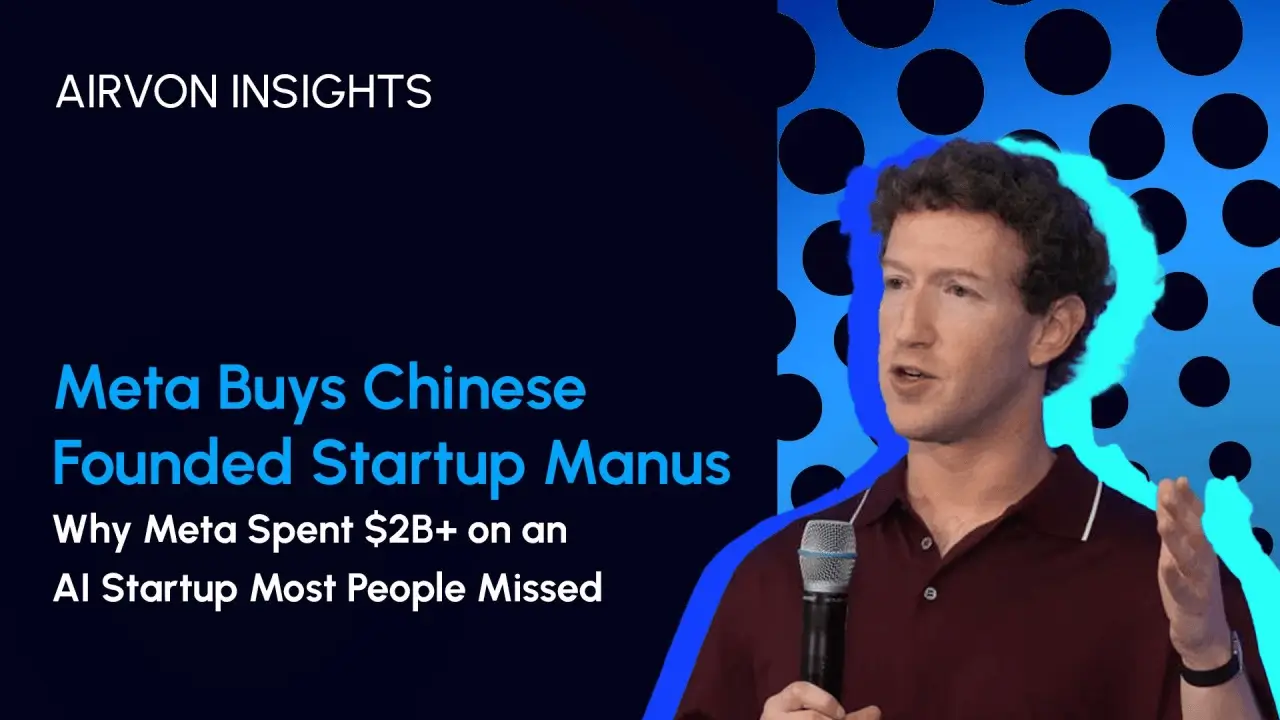
Meta said on Monday it would acquire Chinese-founded artificial intelligence startup Manus, as the technology giant accelerates efforts to integrate advanced AI across its platforms.
Financial terms were not officially disclosed, but people close to the deal say the Singapore-based company was valued between $2 billion and $3 billion.
What Manus Built and Why It Got Attention
Manus drew widespread attention earlier this year on X after releasing what it described as the world’s first general AI agent, a system designed to make decisions and carry out tasks on its own, requiring far less direction than chatbots such as ChatGPT and DeepSeek.
The launch sparked comparisons to DeepSeek itself, with some labeling Manus as China’s next breakout AI success, a narrative that was echoed by Chinese state media.
From China to Singapore in Months
Within months, the company relocated its headquarters from China to Singapore, aligning with a broader shift by Chinese-founded firms seeking to reduce exposure to rising U.S.–China geopolitical pressure.
“Scrutiny is almost guaranteed; anything with Chinese roots and ‘AI’ in the headline now triggers Washington’s reflexes.”
said Jeremy Goldman, senior director at Emarketer.
Why Meta Wanted Manus Specifically
Although Manus does not offer its products inside China, the company says its AI agent outperforms OpenAI’s Deep Research.
It also maintains a strategic collaboration with Alibaba focused on joint work across AI models.
Meta confirmed it will take over the operation and commercialization of the Manus service, folding it into both its consumer and business offerings, including Meta AI.
“We see a natural fit into Meta’s fast-growing WhatsApp SMB footprint, with extensions into CEO Mark Zuckerberg’s agentic-rich vision of personal AI,”
said Barton Crockett, analyst at Rosenblatt Securities.
How This Fits Meta’s Broader AI Strategy
The deal highlights a shift in Meta’s broader strategy. Over the past year, the company has aggressively acquired talent and infrastructure rather than building everything in-house.
Its multibillion-dollar investment in Scale AI, the hiring of Alexandr Wang, and recent acquisitions of AI hardware and wearable startups all point to the same goal: owning the full AI stack from data to deployment.
Manus’ Origins Inside China’s AI Ecosystem
What makes this deal especially notable is where Manus came from.
It began as part of a Chinese startup called Butterfly Effect, raised $75 million in funding led by Benchmark, and attracted backing from Tencent and HongShan Capital, formerly Sequoia China.
The company also formed a strategic partnership with Alibaba’s AI teams, highlighting the deeply interconnected nature of today’s global AI ecosystem.
Yet now, one of the most promising AI agents built in Asia will live inside a U.S. tech giant.
What This Acquisition Really Signals
This acquisition is about where AI innovation is happening, how fast successful products can cross borders, and how geopolitical realities are reshaping the path from startup to scale.
AI is no longer about who has the biggest model. It’s about who ships usable intelligence first, and Meta just bought itself a serious head start.
Conclusion
Meta’s acquisition of Manus is less about headlines and more about execution speed in AI. The deal highlights how agentic systems, global talent, and cross-border innovation now define competitive advantage. AI leadership is shifting from model size to usable intelligence at scale. With Manus, Meta secures an early edge in that race.
Why did Meta acquire AI startup Manus?
Meta acquired Manus to accelerate its agentic AI capabilities and integrate autonomous systems across consumer and business products.
What is Manus and what makes it different?
Manus is an AI startup known for building a general AI agent designed to make decisions and execute tasks with minimal human input.
How much did Meta pay for Manus?
While official terms were not disclosed, sources estimate the deal valued Manus between $2 billion and $3 billion.
Why did Manus move its headquarters from China to Singapore?
The move reduced geopolitical risk and regulatory scrutiny tied to Chinese-founded AI companies.
How does this acquisition fit Meta’s broader AI strategy?
It aligns with Meta’s push to own the full AI stack by combining talent, infrastructure, and deployable intelligence.
