
Why Everyone Is Talking About Vibe Coding
With the advancement of AI a new term called Vibe Coding emerged in the early 2025 and became popular super quickly. The reason was quite simple of how it changed the way a software gets created.
Instead of you coding line by line, anything can be created using AI just by describing what you want.
It will make you worry free from setting up the frameworks, about the syntax. You don’t even need to fully understand how the system works properly at first. You just give a prompt and boom something functional appears.
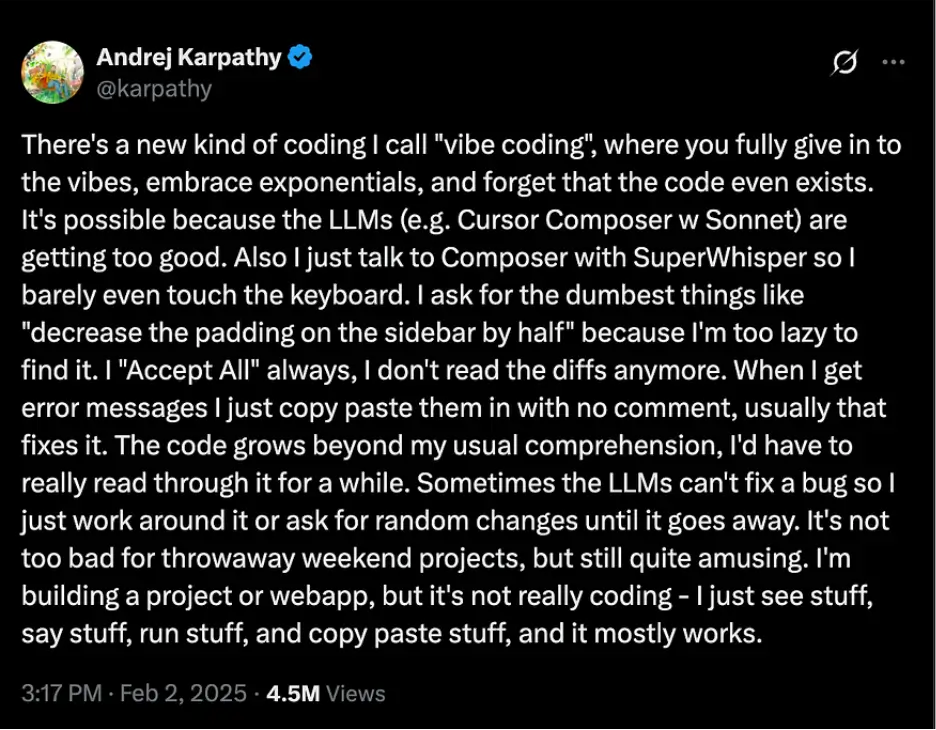
This revolutionary application of AI makes it more demanding. The term “vibe coding” was introduced by Andrej Kapathay and it completely describes the shift from traditional programming to intent-based programming.
You no longer will be coding but will be guiding the AI for the type of product you want.
Since vibe coding has many applications and soon became integrated in workplaces, a new challenge has emerged regarding its maintenance and sustainability.
What Is Vibe Coding?
Vibe coding is the process of building software by describing desired outcomes in natural language and letting AI generate the underlying code.
Instead of manually structuring every component, you give instructions like:
- Build a budgeting app for students
- Create a website for a local gym
- Design a dashboard for tracking customer support tickets
AI tools require proper prompts and they start building the working applications that are demanded from them, including UI, logic and even deployment configurations.
AI tools like Cursor, ChatGPT, and Claude have made development very easy and accessible. A task that required a whole lot of professionals can now be completed in a few hours by a single person.
This is what many AI tools promise but the reality is a bit more complicated.
The Two Phases of Vibe Coding
To comprehend vibe coding completely, let’s look at its two distinct phases.
Phase One: Instant Creation
This is the most appealing aspect of vibe coding.
Just by giving a prompt you can have something tangible within minutes. A product with a fully working interface and all the functional features that can be tested and shared.
For non-technical users, this is a breakthrough experience. It skips the idea stage and allows instant creation with a little experimentation.
This phase is why vibe coding spreads so quickly.
Phase Two: Long-Term Reality
The second phase is the one where the challenges begin.
After the initial exciting phase, practical issues pop up, like can the bugs be debugged without the reliance on AI? Can the system be extended without breaking existing features? Or can another developer understand the code? etc.
Most importantly, can the product survive beyond the demo?
This is where many vibe-coded projects struggle. The gap between “it works” and “it’s reliable” becomes impossible to ignore.
The Hidden Problems Behind AI-Generated Code
At first glance, AI-generated applications often look complete. The interface works, features respond correctly, and everything appears polished.
But under the surface, problems accumulate.An experiment conducted by Stack Overflow highlighted this clearly. A non-technical user built a fully functional review app using AI. It first looked effective and also worked fine.
Later on a deeper observation brought up following serious problems:
- Poor code structure
- Lack of testing
- Security Vulnerabilities
- Incomplete components
AI provides a product that works, not a product that is sustainable. It provides an immediate success that cannot be maintainable in the future. This distinction is crucial.
Without proper oversight, projects become fragile. Small changes introduce new bugs. Performance issues go unnoticed. Security risks remain unaddressed. With time, the developed system becomes hard to manage.
Why Developers Still Get the Most Value
There is a growing misconception that vibe coding eliminates the need for developers. In reality, it amplifies the value of experienced ones.
The professional developers can never be replaced by vibe coding. Instead it increases the value of experienced ones.
AI can only be used to speed up the development process by the professionals. Because experienced developers better understand system design, its architecture, and debugging, they guide the model, review outputs and refine the system.
They can pinpoint when something is wrong even when everything looks correct and how to fix it properly. Due to this major difference developers will always be in demand.
Non-technical users rely on AI to build. Developers use AI to accelerate.
The role of developers is itself evolving where they are focusing on designing systems, validating logic and ensuring reliability.
The Best Vibe Coding Tools Right Now
There are many tools for vibe coding offering services to different types of users.
Tools built for beginners prioritize speed and simplicity. Beginners can create applications with minimal effort, through chat-based interfaces. These AI platforms are suitable for quick prototypes, landing pages and internal tools.
While more advanced tools offer a deeper control to its users. They merge seamlessly into developer workflows, provide clear visibility into code and build more complex systems. These tools are ideal for long term development of scalable projects.
Tools for such projects are Replit used for rapid prototyping and deployment, GitHub Copilot for enhancing productivity and existing codebases.
The Real Risk: Losing Control of Your Codebase
The biggest issue with vibe coding is that you will lose control of your codebase.
Each new prompt will implement new changes in the code that may not fully align with the previous one. Making the system inconsistent with time. The logic overlaps and dependencies become unclear.
Eventually, even simple updates become risky.
This is often described as “prompt stacking”, continuously adding new instructions without cleaning up or restructuring the underlying code. This makes the system lack clarity.
Making debugging difficult, and scaling nearly impossible. Reducing speed turning it into a liability.
How to Use Vibe Coding Effectively
Vibe coding can create exceptional products when used with proper discipline.
The best strategy is to treat AI-generated code as an initial draft instead of a finished product. Building in small portions can help maintain clarity and control.
It is important to understand the code before accepting it. Even a minor review can help prevent major issues later on. Completing coding components in modules reduces the risk of breaking unrelated features and allows easier updates.
Aggressive testing is essential. It ensures that changes do not introduce hidden problems. Same goes for security considerations, they should also be addressed from the beginning.
Lastly, version control is also very important. As without proper version control, tracking changes and reverting mistakes becomes difficult.
Follow up of these practices defines whether the project will be a hit or miss.
The Rise of a New Type of Builder
Vibe coding is creating a new category of builders.These individuals can launch products quickly, experiment with ideas, and bring concepts to life without traditional technical barriers. This is a significant shift.
Vibe coding has created a new category of builders. These builders are able to launch new products quickly, experiment with ideas and bring them to life without traditional technical barriers. Making this an important update.
Nevertheless, many of them still struggle with sustainability, debugging, and scaling. Which creates a gap between creation and its maintenance. Removing this gap will definitely be a successful upgrade in this landscape.
The Future of Vibe Coding
Vibe coding is a fundamental shift in how a software is built, not a passing trend. As soon as the AI toll improves, the quality of generated code will enhance. Making the workflows more organized and integrations more efficient.
But the main challenge of understanding the code will remain the same. AI can generate code in a matter of seconds but still cannot fully replace human judgement. Human input will still be required for architecture, trade-offs and long term strategy.
In the future the developers and non-developers will learn how to collaborate with AI effectively. Instead of AI replacing developers. It will only be used to speed up a complex process.
Making ease for those who use it strategically instead of those who trust it blindly.
Conclusion
Through vibe coding the building of software has significantly become faster than ever, but it has also masked the real difficulties. AI tools like ChatGPT and Cursor can turn ideas into working products in jiffies, removing the manual effort of typing the code line by line.
But speed does not hide the complexities underneath. When something in the code needs an upgrade or needs to be scaled, the lack of code understanding becomes a great barrier in progress, creating chaos and confusion.
The perfect strategy to get maximum results is to know how to work with AI, not just command it. Building is comparatively easy from maintenance, debugging and improving the existing code built through AI.
Those who take time to understand the code, question outputs, and refine structure will stay ahead. Vibe coding isn’t replacing skill, it’s changing what skill looks like.
What is vibe coding in simple terms?
Vibe Coding is a type of coding AI does to develop a software through a given prompt by you.
Who invented the term vibe coding?
The term was introduced by Andrej Karpathy in 2025.
Is vibe coding suitable for beginners?
Yes it is suitable for beginners as well as professionals. However, beginners may have a hard time maintaining and debugging projects without proper technical knowledge.
Can vibe coding replace developers?
No, this is a widely accepted misconception. Vibe coding can never replace professionals because it does not have the technical expertise especially for complex and scalable systems.
What are the risks of vibe coding?
Poor code quality, lack of testing, security vulnerabilities and difficult maintenance and scalability of projects over time are the main risks of vibe coding.
Which tools are best for vibe coding?
Popular tools include ChatGPT, Cursor, Claude, Replit, and GitHub Copilot.
How can I avoid problems when using vibe coding?
Understand the generated code, Build in small intervals and start testing exercises early-on with clear structure maintenance and version control.
