

This past week, OpenAI introduced OpenAI Frontier, a new platform designed to help companies build, deploy, and oversee AI agents.
The timing here is very crucial. Software stocks from PayPal to Expedia and Intuit fell more than 10% earlier this week, wiping over $300 billion off software and data stocks.
Investors reacted to a simple fear: if AI agents can do the work, what happens to traditional software? OpenAI Frontier lands directly in the middle of that tension.
What Is OpenAI’s Frontier?
Frontier is a platform that helps companies build and manage AI agents that work across systems, pull in data, run code, and complete tasks.
It integrates with OpenAI’s previously announced agent-building tools. The goal is to make it easier for businesses to combine the data sources agents need to operate. These agents can process information from multiple systems and take actions such as working with files or executing code.
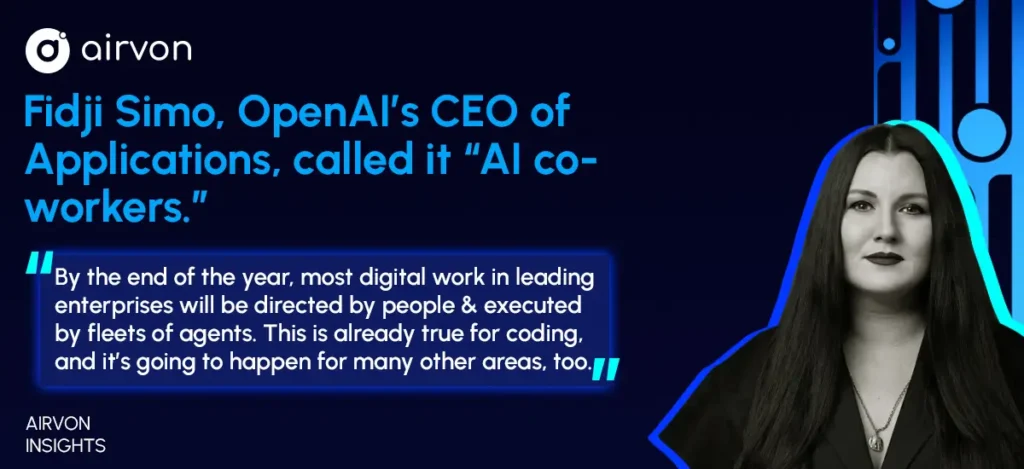
OpenAI’s CEO of Applications, Fidji Simo, described these systems as “AI co-workers.”
She added:
“By the end of the year, most digital work in leading enterprises will be directed by people and executed by fleets of agents. This is already true for coding, and it’s going to happen for many other areas, too.”
OpenAI Frontier is currently available to a limited set of customers. OpenAI has not disclosed pricing.
How Is Frontier Positioned in the Market?
This week’s market reaction reveals investor concerns.
Anthropic expanded its Cowork assistant, powered by Claude, adding plug-ins for specialized business functions, including legal workflows. OpenAI also released a new version of its coding tool, Codex, moving in a similar direction.
Investors see automation putting pressure on traditional SaaS products: fewer seats, fewer licenses, and fewer tools if agents can handle workflows directly.
Simo addressed this directly. She said:
“We’re not going to build every single AI agent that companies need. That’s why we have built the platform in a way where all these software companies can deploy their agents on top of us.”
This positioning matters. Frontier is not pitched as a replacement layer. It is framed as a distribution and orchestration layer. OpenAI aims to become the standard infrastructure where enterprise agents live — whether built by OpenAI, Microsoft, Oracle, SAP, or others.
How Frontier Fits Into Enterprise Systems
For agents to function in real business environments, they need access to real data. In some cases, they must pull data from:
- Customer relationship management systems like Salesforce
- Messaging platforms like Slack
OpenAI has also struck deals with companies such as ServiceNow to integrate its models directly into ServiceNow’s AI agents.
Initial Frontier customers include Uber, Thermo Fisher Scientific, and Intuit. Dozens of other OpenAI clients are testing the product.
Is Frontier a Competitive Strategy?
OpenAI is competing with Anthropic, Google, and others for corporate AI budgets.
Enterprise customers want control. They do not want isolated tools. They want systems that connect across their stack. By positioning Frontier as a neutral platform where different agents can run, OpenAI is expanding its ecosystem.
If companies build their agents on top of Frontier or route them through it, OpenAI becomes embedded in core business workflows. That strengthens its enterprise footprint at a time when it is reportedly laying the groundwork for a public listing in the fourth quarter of this year.
What Changes Inside Companies?
If OpenAI’s forecast holds, enterprise work shifts: people define goals, agents execute tasks, and managers oversee systems rather than individual contributors.
This is already visible in coding. AI tools draft code, run tests, and fix errors. Humans review, direct, and approve. Frontier aims to extend that pattern into finance, legal, operations, customer support, and beyond.
Five Governance Questions Every Team Should Ask Vendors
If you’re assessing Frontier, another platform, or building in-house, the same scrutiny applies. Any vendor positioning itself as your agent oversight layer should answer these clearly:
1. Incentives and Independence
Does the governance vendor also build foundation models or agents? If so, how are conflicts of interest managed? Can you verify that their own systems aren’t favored in evaluations, tuning cycles, or performance reporting? Is third-party auditing possible?
2. Handling Agents That Evolve
Are controls fixed, or do they adapt as agents learn? Can the system detect behavioral shifts over time? If an agent updates through reinforcement learning or ongoing context accumulation, can you roll back changes, review what was learned, and test updates safely before redeployment?
3. Data Rights Inside the Feedback Loop
Who owns the operational data generated by your agents? Can the governance provider use that data to improve its broader platform or other customers’ systems? If you switch vendors, what happens to your historical traces and learning data?
4. Depth of Visibility
Does oversight stop at outputs and logs, or does it include deeper model signals? When using third-party models, what telemetry is accessible? How quickly can the system detect abnormal behavior? Does detection rely only on analyzing outputs after the fact?
5. Portability and Transparency
Can you move your governance setup elsewhere if needed? Are policies, evaluation settings, and audit logs exportable in open formats? Can you independently verify what actions the governance platform itself took using tamper-resistant records?
What Frontier Means for SaaS
The market fears that AI agents will reduce the need for traditional SaaS tools. OpenAI Frontier suggests a different direction.
Instead of replacing software, agents may sit on top of it. CRM systems still store customer data. ERP systems still manage operations. Messaging apps still coordinate teams. Agents connect to them, retrieve data, and act.
That is why OpenAI framed Frontier as positive for the sector. Whether the market agrees will depend on adoption speed and cost efficiency.
What is OpenAI Frontier?
OpenAI Frontier is an enterprise platform that enables companies to build, deploy, and manage AI agents that can access data, run code, and execute tasks across different business systems.
How is Frontier different from traditional SaaS tools?
Frontier is positioned as an orchestration and distribution layer rather than a replacement for SaaS. Instead of replacing software, it allows AI agents to sit on top of existing systems and operate across them.
Who is Frontier designed for?
Frontier targets enterprise customers that need AI agents to work across CRM systems, messaging platforms, operational tools, and other core business software.
How does Frontier fit into OpenAI’s competitive strategy?
Frontier expands OpenAI’s enterprise footprint by serving as neutral infrastructure where different agents can run, whether built by OpenAI or other software providers.
What governance considerations should companies evaluate?
Teams should assess vendor independence, how evolving agents are controlled, data ownership rights, depth of oversight visibility, and portability of governance systems before adopting any agent platform.
