
If you work in retail or eCommerce, you need to know that shopping is moving away from people clicking through pages. AI agents are starting to act on behalf of customers. And big tech is racing to own that layer.
Google’s recent announcement of Universal Commerce Protocol make one thing clear. Agentic commerce is being built into the core of how retail will work. This shift affects global brands. It also matters deeply for emerging markets like Pakistan.
Retail Is Moving From Search to AI-Led Action
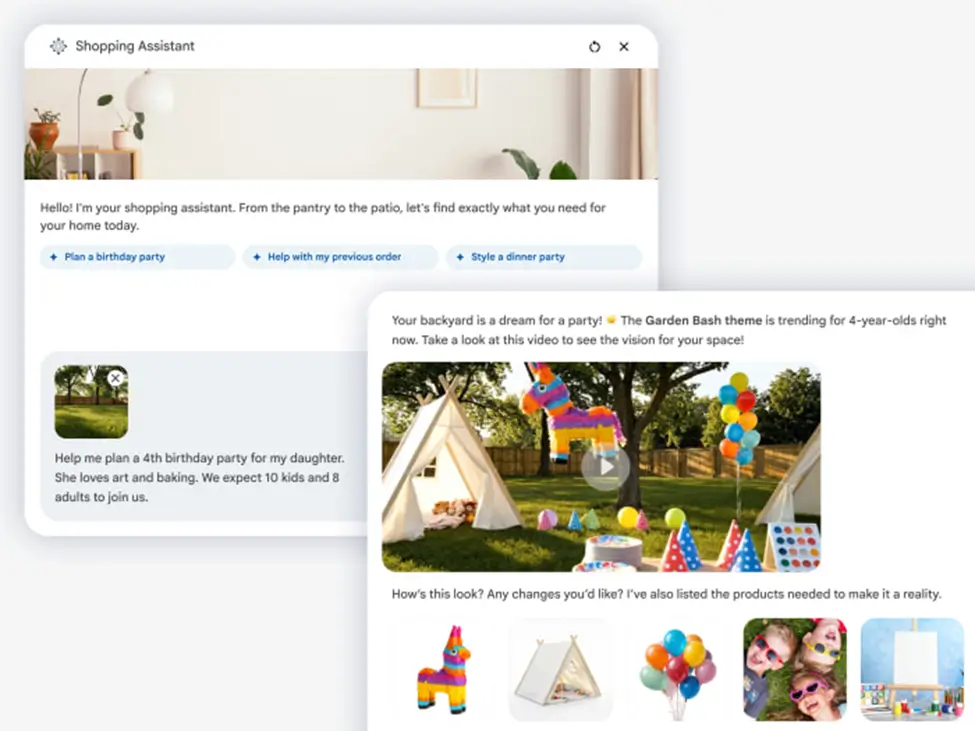
Google has officially entered AI-agent based shopping with a new set of tools for retailers under Gemini Enterprise for Customer Experience. These agents don’t just answer questions. They help shoppers find products, compare options, place orders, and get support.
Major retailers including (famous grocers) Kroger is testing Google’s shopping agent inside its app. The agent understands context like time constraints, meal plans, price sensitivity and brand preferences, then completes purchases using Kroger’s own customer data.
“Things are moving at a pace that if you’re not already deep into AI agents, you’re probably creating a competitive barrier or disadvantage.” – Yael Cosset, Kroger’s Chief Digital Officer
Home improvement giant, Lowe’s Companies, Inc. uses Google’s agent as the backend for its virtual assistant Mylow. The company says customer engagement with Mylow more than doubles conversion rates.
Papa Johns is testing Google’s food ordering agent that can estimate order size from images and sync menus in real time across phone, app, web, and in-car systems.
As Papa Johns’ CTO Kevin Vasconi said:
“I don’t want to be an AI expert in terms of building the agents. I want to be an AI expert in terms of how I use the agents.”
This is the pattern that we see as retailers don’t want to build models. They want systems that act.
Why Retailers Want Their Own AI Agents
Retailers face a real risk when shopping moves inside third-party chatbots like ChatGPT, Copilot, or Gemini.
If checkout happens there, brands lose:
- Direct customer interaction
- Cross-sell and upsell moments
- Control over how products are presented
Lauren Wiener from Boston Consulting Group explains why retailers are building their own capabilities:
“There’s a market shift across the spectrum of retailers who are investing in their own capabilities rather than just relying on third parties.”
Google’s pitch to retailers is to give them control. Build your own AI agent powered by Google’s infrastructure, but owned by you. Whether that control holds long-term is still an open question.
Universal Commerce Protocol and the Illusion of Neutrality
At NRF, Google announced the Universal Commerce Protocol (UCP). Twenty major retailers signed on including Walmart, Target, Shopify, and Etsy. Payment giants like Visa, Mastercard, and PayPal joined as well.
The promise is an open standard that lets AI agents shop across platforms without custom integrations.
The data shows that the behavior is already changing.
Who Owns the Journey?
Google positions UCP as an open standard. But it sits on top of infrastructure Google already controls.
Google’s Shopping Graph includes 50+ billion product listings
2 billion listings refresh every hour
People shop across Google over a billion times per day
Richard Crone, CEO of Crone Consulting, explains the risk clearly: If checkout shifts to AI agents, merchants lose the final customer touchpoint where 33% to 76% of upsell and cross-sell revenue typically happens. But as this ecosystem evolves, owning the transaction does not equal owning the journey.
What This Means for Pakistan’s Retail Ecosystem
For Pakistan, this shift is both a risk and an opportunity. Local retail today is fragmented and many businesses still rely on:
- Manual WhatsApp ordering
- Phone calls
- Basic ecommerce setups
- Limited data on customer behavior
AI agents can change that fast as it can:
- Turn conversational commerce into structured systems
- Help small retailers compete on discovery and not just price
- Reduce reliance on paid ads by optimizing AI-led product discovery
- Enable local languages and voice-based shopping for wider access
But there is risk as AI agents are controlled by global platforms, local retailers could lose:
- Direct customer relationships
- Control over margins
- Visibility if their data feeds aren’t optimized
For Pakistan’s ecosystem, the winners won’t be those with the biggest brands. They’ll be the ones who:
- Structure product and inventory data cleanly
- Integrate early with agent-ready platforms
- Treat AI agents not as a feature but new storefront
This is where local platforms, system integrators, and infrastructure providers matter more than ever.
Conclusion
AI commerce is shifting control of shopping from websites to agents that act on behalf of customers. As checkout moves into AI-led systems, owning the transaction no longer guarantees owning the customer journey. For retailers, early integration and clean product data will define visibility and margins. In markets like Pakistan, AI agents are not just a risk but a new storefront.
What are AI shopping agents?
AI shopping agents help customers discover products, compare options, place orders, and receive support without manual browsing.
Why are retailers building their own AI agents?
They want to retain control over customer relationships, product presentation, and upsell opportunities.
What is the Universal Commerce Protocol?
It is Google’s proposed standard that allows AI agents to shop across platforms without custom integrations.
Why is control of checkout important in AI commerce?
Checkout is where most upsell and cross-sell revenue occurs and where customer relationships are reinforced.
How does AI commerce impact Pakistan’s retail ecosystem?
It can modernize fragmented retail, enable conversational commerce, and help small businesses compete if they integrate early.
